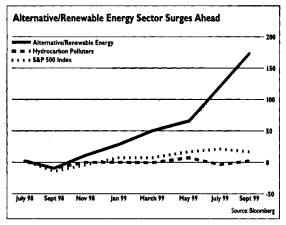
Renewable Energy Industries
Purpose: To reduce or eliminate our dependence on fossil petroleum and other high-risk, high-cost technologies such as nuclear power that require huge capital investments with substantial longer-term liabilities.
If power production can reduce or effectively manage fossil carbon (such as those sources that produce carbon dioxide and other greenhouse gases), increase energy supply security, and preserve petroleum assets for those applications for which there is not yet a suitable alternative, there are economic and environmental advantages to renewables that make them attractive investment targets.
With many technologies now proven in photovolatics (PV) and wind power generation, project finance in these areas has gained substantial momentum in recent years. In the hands of the right management teams, correctly sited, with incentives, effective power purchase agreements and financing, this has become an attractive opportunity, especially in the current economy.
Certainly there are further efficiency gains to be made by manufacturers, but already PV and wind power have become key areas of innovation, job creation and return on capital.
Renewable Energy Technologies and their Status
Solar / Photovoltaic
Many types of PV panels have sufficient history (not to mention manufacturers' 25- to 30-year warranties) to fit the low-risk or no-risk profile required for successful power generation projects.
Technical Background: Photons in sunlight interact with the outermost electrons of an atom. Photons striking the atoms of a semiconducting solar cell free its electrons, creating an electric current. That current can be converted and used instead of or in addition to electric grid power. Where there is no power grid, solar power makes an excellent distributed energy source. Other opportunities include replacing dirtier sources for heat and light (such as kerosene or diesel generators) in remote or developing economies with no infrastructure.
Two main types of PV panels: crystalline (silicon), and thin film. Crystalline silicon cells are produced by slowly extracting large crystals from a liquid silicon bath. These crystals are sliced into 1/100th-of-an-inch thick slices, or "wafers", which are processed into solar cells that are then connected and laminated into solar "modules." While this production process yields highly efficient (10-15%) cells, the production process is expensive.
By contrast, thin-film silicon cells are produced by depositing vaporized silicon directly onto a glass or stainless steel or other substrates. While the efficiencies achieved have traditionally been lower than with crystalline silicon, the production process is faster and less expensive. According to their own reports, nanotechnology has been used to develop a thin-film photovoltaic device made on flexible material. See Nano Solar's website for details.
Build-integrated photovoltaics (BIPV) refers to a building that has solar devices designed into the architecture, as part of the "skin" of the building.
PV prices have dropped while efficiencies have generally increased over the years. Depending on when and where they are installed and how they are financed, rebates, tax credits, and other subsidies can make PV projects an attractive investment.
Wind Power
The economics for new turbine and wind power generation systems have reached parity with fossil fuel or carbon-based sources, with none of the environmental downsides. Wind energy is one of the cleanest forms of energy around. It is non-polluting and minimally disruptive to the natural environment, with no emissions, excessive noise or waste heat byproducts. Recent technology advances have reached a price/performance mark that makes wind highly profitable while simultaneously reducing risk to migratory birds by increasing the size and visibility of the blades, slowing the speed of rotation and using tubular towers with internal ladders and underground wiring to eliminate roosting and nesting sites on the structure itself. The only questions are how quickly will we adopt wind power sources and who will benefit.
Prediction that Wind Power would become the world's leading energy source Lester Brown article (2003) from the Earth Policy Institute.
See also the US Dept. of Energy's Energy Information Administration statistics and trends database or Navitas / Gamesa www.windpower.com for additional wind power projet information.
Biomass & Methane Co-Generation
Environmentally sustainable power generation in remote areas using plentiful, renewable sources and surplus materials, such as agricultural waste (biomass), garbage, or saw dust have already been demonstrated.
The practice of co-generation of electricity from methane is already in widespread use at landfill sites and large, methane-producing lakes. If the fire hazards can be managed effectively, there are significant opportunities -- economic advantages as well as strong environmental benefits -- in methane capture.
Geothermal
Geothermal energy has the potential to make a significant, clean and economally-competitive contribution to the energy supply. The US Dept. of Energy (Energy Efficiency and Renewable Energy program) stated that the overall performance goal for 2010 is that "the levelized cost of power generated from geothermal sources will be reduced from 5-8 cents in 2000, to 3-5 cents per kWh." See the Geothermal Resource Council set of presentations for details. US National Renewable Energy Laboratory (NREL) has a similar message in their Geothermal Technologies Program website.
Biofuels: Biodiesel & Biohols
Biodiesel is diesel fuel generated from renewable sources such as (most common in Europe) rapeseed / Canola, or certain varieties of mustard, sunflower and others. Biodiesel is comparably priced and burns cleaner compared to conventional, petroleum-based diesel fuel. Many regions, such as California, now require significant reduction in diesel-produced sulfur; biodiesel/petroleum diesel blends can provide an excellent, cost-effective solution.
There is presently far more biodiesel production capacity than feedstock in the US. The industry needs to mature and prove economics through efficiency, scale, feedstock selection, and cost-effective use of byproducts such as glycerine. These technologies now exist and several development projects are funded through this forum's affiliates. Feedstocks such as jatropha trees, experimental drought-tolerant agricultural crops, and algae aquaculture all hold promise. Stay tuned.
Biohols such as biobutanol or even octanol (far greater energy density than ethanol) from food-friendly sources present another set of opportunities. These technologies are still too early stage as of this writing to consider them viable for projects that typically do not tolerate risk. Stay tuned to blogs and venture press releases for evidence of commercial proof-of-concept.

Distributed Power Solves Health and Environmental Problems in the Developing World
Like conventional solar and wind, they deliever the additional advantage of distributed power generation: affordable electricity can be made available to remote villages and developing communities that might otherwise be without it.
For example, solar is being used to replace toxic kerosene in lanterns, and biodiesel produced from local biomass is being used to replace petroleum diesel fuel for power generators in many parts of the developing world. Small-scale power from clean sources bypasses the need to sacrafice the environment or human health and safety for the conveniences of electricity.
Other Technologies, Conservation & Energy Efficiency
When considering a renewable energy installation or project investment, energy efficiency can significantly improve the overall financial outlet. For example, in addition to generating power, rooftop PV devices provide additional insulation, thereby lowering overall cooling costs. Other efficiency gains in lighting, heating, ventilation, thermal insulation, electric motor efficiency, and overall building design can contribute as well.
Ocean Currents, low-emission and closed-loop Liquid Natural Gas, Small-scale HydroElectric, Nanodevices and other technologies are under development, but generally too early stage (still technology and/or market risks) to be considered for project finance.